Raymond Horgan
Presumed InnocentRaymond Horgan is Kindle County’s veteran prosecuting attorney, a political leader whose authority rests on years of office, carefully managed public standing, and personal ties within the legal establishment. Carolyn Polhemus’s murder exposes the strain beneath that authority: Raymond is grieving, campaigning for his position, struggling to manage his office, and increasingly at odds with Rusty Sabich, the deputy he once trusted. His arc moves between mentorship and accusation, public performance and private admission, without resolving the institutional and personal failures that bind him to the case.
Identity and Public Position
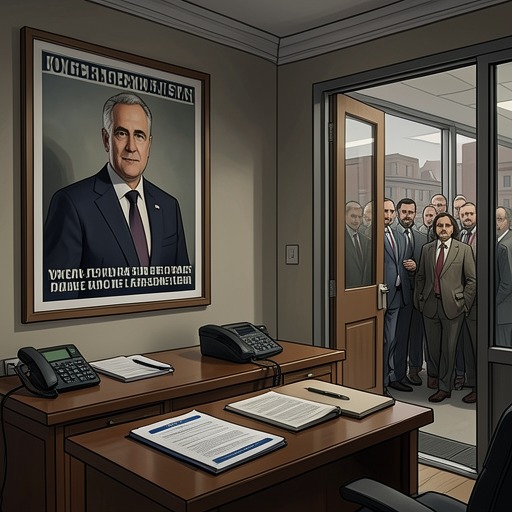
Raymond has led the prosecuting attorney’s office for twelve years by the time the novel’s opening campaign reaches its final stretch. He is separated from his wife, has gained weight, and carries a habitual grimness that colleagues read as evidence of a man who no longer expects painful circumstances to improve. His campaign image attempts to turn that weariness into solemnity and courage: a photograph with a coaxed smile appears on city buses, but Rusty regards it as a sign that Raymond has fallen out of step. The contrast between the composed candidate and the tired man in the county car establishes a recurring tension in his characterization: public appearance is something he can arrange, but not fully control.
Raymond’s political position is unusually secure in one respect and precarious in another. In a county where the party primary is effectively the election, he has won voters for more than a decade, yet this campaign is troubled by an old factional dispute with the mayor and by Nico Delia Guardia’s challenge. Raymond waited until four months before the primary to announce his candidacy. Rusty believes hatred of his former deputy may have mattered more than devotion to public life in prompting him to run again. Raymond’s campaign team expects party leaders to pressure the mayor into backing him, but confidence does not prevent him from losing control of the practical work: two weeks before the election, he discovers the office has not commissioned a poll in two months and lacks anyone clearly running it.
His authority also rests on negotiated accommodations with the party organization. Years earlier, Raymond agreed with Augustine Bolcarro that most office staff could take Election Day off to fulfill political obligations. He had otherwise discouraged his employees from active campaigning and had never asked them for donations or campaign labor. In the election that threatens his tenure, that arrangement sends staff members to work for Nico Delia Guardia. Raymond’s impartiality toward office employees and his dependence on party structures thus coexist uneasily: he can limit direct political solicitation inside his office, but he cannot prevent the institution from being entangled in the party’s machinery.
Leadership, Ambition, and the Night Saints Investigation
Raymond helped advance Rusty’s career by selecting him to lead a large police and grand-jury investigation of the Night Saints, the city’s largest street gang. The operation began during Rusty’s fourth year as a deputy and took almost four years of his life. Raymond announced it in time to make it the centerpiece of his first reelection campaign, presenting it as a major achievement and a useful answer to the public perception that he was soft on crime. The campaign could claim 147 convictions, while more than 700 gang members remained at large. The difference between the celebrated tally and the continuing presence of the gang complicates the triumph Raymond’s office claimed for the investigation.
The assignment made Rusty more visible and placed reporters beside him, but it also shows how Raymond joined prosecutorial work to electoral strategy. His sponsorship brought his deputy a consequential professional opportunity; the investigation’s public value, in turn, served Raymond’s political needs. This pattern helps explain the intimacy and imbalance of their relationship. Raymond’s mentorship is genuine enough to make Rusty a favored deputy, yet it belongs to an office where career advancement, enforcement, and campaign advantage can converge.
The pressure of Carolyn’s murder intensifies Raymond’s sense that he is losing command of events. He remembers her first as a probation officer, then as a deputy prosecuting attorney whom he hired; he calls her capable and a strong lawyer while confronting the fact of her death. At the same time, he resents the political exploitation of the case. He complains that Nico is using the killing to implicate him and that the press expects an immediate solution. The mayor even suggests that solving the murder before Election Day would help Raymond’s chances, a proposal Raymond regards as politically self-serving. His grief is therefore inseparable from the campaign’s demands and from his awareness that the office’s response will be judged as a public performance.
Carolyn Polhemus and the North Branch Scandal
Raymond’s connection to Carolyn includes a brief personal relationship late in the year before her death. He acknowledges it publicly at Rusty’s trial, after first identifying her as a former probation officer and an attorney employed in his office for eight years. That disclosure makes Raymond more than a senior official commenting on a former employee: he is a witness with a personal history of his own, and his knowledge bears directly on the question of what Rusty should have told him while investigating Carolyn’s murder.
A later confrontation with Rusty reveals the older professional history Raymond shares with Carolyn and Larren Lyttle. According to Raymond, Carolyn had advocated for defendants on bond and Lyttle had granted favorable treatment; one defendant later gave her money. She brought the payment to Lyttle, who treated the matter lightly, and the incident developed into a personal relationship between them. Raymond says Lyttle told him about it once. He hired Carolyn after Lyttle described her financial difficulties, doubled her salary, and instructed her to stop the improper conduct. Raymond says he intended to keep her in a deputy role, but she proved highly capable; he later transferred Lyttle downtown, where Lyttle performed with distinction. Raymond also maintains that Carolyn and Lyttle had become so estranged professionally that they barely spoke in the years before her death.
This account complicates Raymond’s insistence on professional propriety. He knew of misconduct associated with Carolyn and Lyttle, yet chose to hire her and believed the matter had ended. Rusty accuses him of lying about the B file Raymond had given him and about describing the allegation as baseless. Raymond does not answer that accusation with a straightforward account of the file; instead, he rejects the idea that the past scandal had anything to do with Rusty’s murder charge and insists that no one involved was a hero. His explanation makes the old affair more legible, but does not remove the question of why he had earlier minimized or misrepresented what he knew.
A further account of Raymond’s possible involvement in the North Branch corruption investigation remains explicitly uncertain. Sandy Stern tells Rusty that, according to people who feared a wider inquiry, investigators believed the prosecuting attorney should be informed. Stern suspects that Raymond would then have warned his old friend Lyttle and pressed him to stop, but emphasizes that he cannot confirm the story and never tried to verify it. Raymond’s position in the scandal is therefore not established as fact by this account; its importance lies in the suspicion cast over the trust linking the prosecuting attorney, the judge, and the people investigating the court.
Rusty Sabich: Mentor, Witness, Adversary
Raymond’s relationship with Rusty shifts from professional confidence to public estrangement. On the eve of the election, he tells Rusty he intends to offer Nico an early resignation rather than remain a lame-duck prosecutor. He also apologizes for not having tried to make Rusty his successor, saying that he would have preferred Rusty to take over but that political supporters had pushed him to run again. Rusty refuses the apology. Raymond’s regret suggests that their professional bond had included a genuine expectation of succession, even as the election prevents it from being realized.
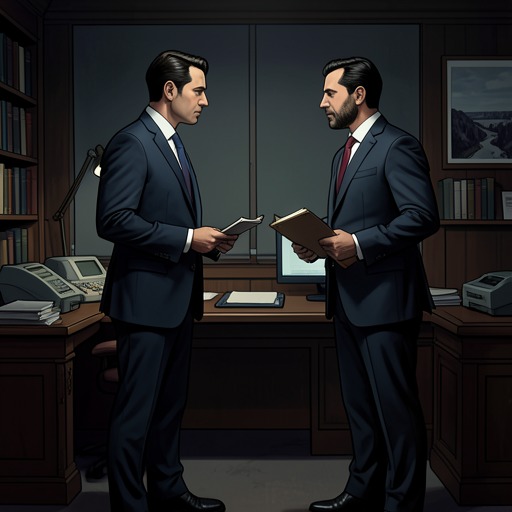
After Rusty is accused of murdering Carolyn, Raymond’s earlier intimacy becomes a source of anger. In Raymond’s office, he confronts Rusty over the fingerprints found on the glass and over Rusty’s questions about his sexual relationships. He says Rusty should have disclosed his relationship with Carolyn when Raymond assigned him to the investigation, rather than raising the matter later under circumstances that now look self-serving. Raymond also recalls reprimanding Rusty for failing to push the investigation hard enough. His accusation is personal, but it is framed as a breach of professional conduct: the deputy concealed a conflict while handling a case that implicated both men’s private lives.
At trial, Raymond appears in the same blue serge suit he wore to Carolyn’s funeral. He acknowledges Rusty in court and confirms their long professional association before describing his own relationship with Carolyn. Asked whether Rusty should have told him about the affair, Raymond says he would have expected disclosure and would not have allowed Rusty to handle the investigation. He argues that the public should be able to see that official decisions were made for professional rather than personal reasons. The testimony sharply injures Rusty’s defense, because it turns their old working relationship into evidence against him.
Sandy Stern’s cross-examination presses the contradiction between Raymond’s former confidence in Rusty and his present disavowal. Raymond eventually concedes that disclosure would have looked better for Rusty and for himself. The admission does not undo his testimony, but it exposes an element of self-interest in his position: the failure to disclose damages Raymond’s own standing as the official responsible for assigning the investigation. The trial presents him neither simply as a loyal mentor nor simply as a hostile witness, but as a former superior whose professional judgment and personal injury have become difficult to separate.
Defeat, Appointment, and Unfinished Consequences
Raymond loses the primary to Nico Delia Guardia. On Election Day, his allies still hope that favorable weather and a late recovery in support might save him, but the office’s employees spend the day performing party work for his opponent. Raymond has already accepted that defeat may bring pain, and he tells Rusty he plans to leave cleanly rather than manipulate the office during a transition. His decision marks a retreat from the authority he has held for twelve years, though it does not end his influence in county politics.
After the trial, Raymond serves on a citizens’ commission formed to recommend a new prosecuting attorney. Rumor has it that Mac was the first choice, but she declines to leave the bench. Raymond contacts Rusty, assures him that support has been sounded, and helps bring about his appointment as acting Kindle County prosecuting attorney. Rusty accepts without intending to run for reelection and becomes a caretaker prosecutor. Raymond’s role in that appointment reverses the earlier failure to make Rusty his successor: the political conditions have changed, and the former deputy returns to the office under the shadow of the case that divided them.
The return offers no clean reconciliation. Rusty describes his public standing as permanently marked by the murder prosecution and says that the case remains unsolved. Raymond’s career survives his electoral defeat through his continued participation in the county’s political and legal establishment, while his relationship with Rusty remains edged by accusation, disappointment, and dependence. His significance lies in that unresolved overlap: he is at once a mentor who helped shape Rusty’s career, a witness whose testimony damaged him, an official implicated in contested histories of institutional conduct, and a political actor who ultimately helped place Rusty back in the office.